No such ventures, Cloudflare: Builders CTO Network Breakfast recap
CTO
6 min
30 Oct 2025
Infrastructure costs forcing rethinks; EU compliance as a secret advantage; and cloud bills that don't make sense anymore. These are the conversations that unfolded when CTOs gathered at No Such Ventures for the CTO Network Breakfast.

Sharon Klaver
Intro
Recap
Business idea scope
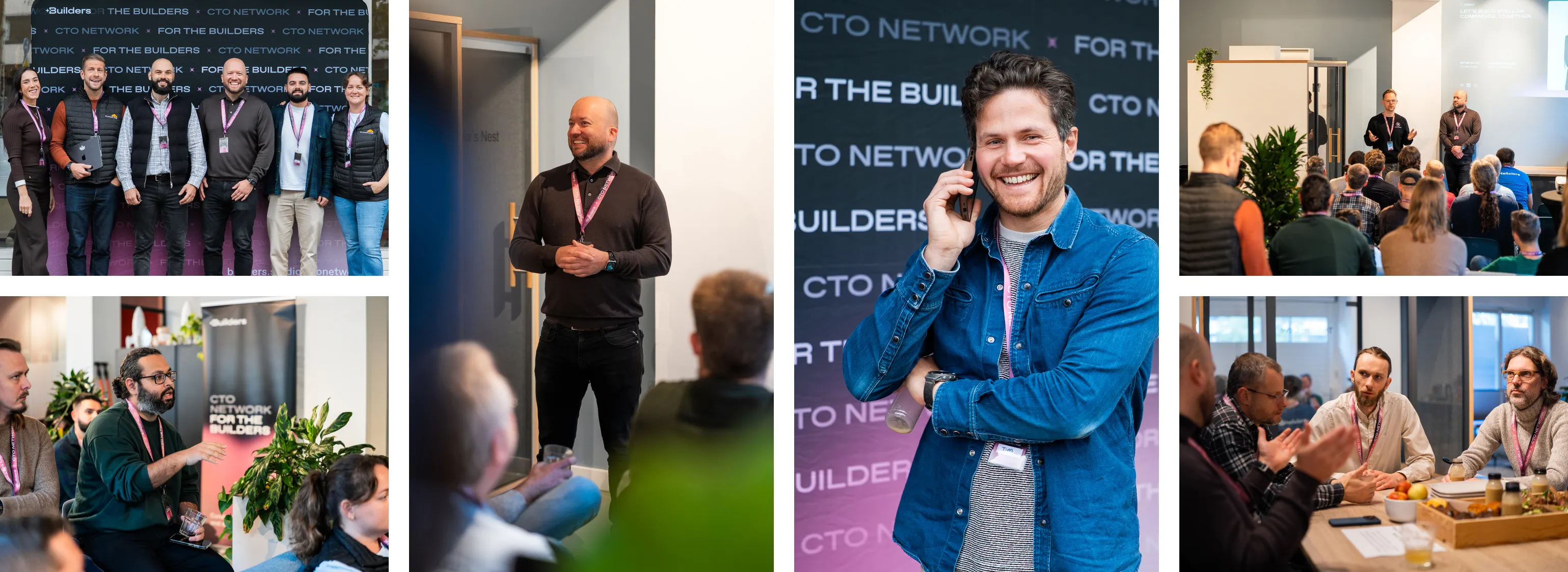
Long before the Amsterdam traffic reached full volume, we gathered at No Such Ventures’ Wibautstraat office for our CTO Network Breakfast. A room filled with about 30 CTOs and technical leaders from across Europe, all carrying different architectures, different stacks, and different scars. The setup was intentionally simple: coffee strong enough to wake a Kubernetes cluster, warm pastries, and a space deliberately designed for technical honesty. No slideshows, no marketing pitches, just engineers comparing what they’re building, what’s breaking, and what keeps them awake at night.
Warming up the room
The conversations started even before the event officially did. As people filtered in, the talk ranged quickly from venture dynamics to the reality of building infrastructure-heavy companies in Europe. Michael van Lier kicked things off with a familiar mix of candor and curiosity: an introduction to the Builders ecosystem, a reflection on the European VC landscape, and a quip about AWS reliability that had several people nodding with painful recognition. It set the tone — this was not a room for theoretical strategy or high-level abstractions. This was a room where people wanted to understand how things actually work.
Cloudflare’s evolution and why it matters now
The morning’s first deep dive came from Michael G. of Cloudflare, who walked the room through the company’s journey from “CDN with attitude” to a full-stack compute platform. What resonated wasn’t just the scale - 300+ global data centers - but the conceptual shift beneath it. Cloudflare’s V8-based Workers architecture does away with cold starts altogether. Instead of waiting 50–150ms for a Lambda container to wake up, Workers start in around 5ms because the code never sleeps. It reframed serverless not as a lightweight abstraction on top of containers, but as a fundamentally different compute model.
And beneath the technical polish was something more provocative: the economics. Cloudflare’s acquisition-model analysis, showing an 86% cost reduction compared to traditional cloud workloads, drew a ripple of raised eyebrows across the room. Not because people doubted it, but because so many found themselves paying for “idle” cloud time they could no longer justify. As Michael put it bluntly, “You only pay for CPU time, not wall time.” It was the type of detail that quietly rewires an architecture decision in the back of someone’s mind.
The Q&A and the practical realities behind migration
The Q&A quickly moved beyond theory into the messy truth of legacy systems. Several CTOs acknowledged the gravitational pull of large, monolithic codebases, structures built before serverless was even a consideration. Michael didn’t romanticize the trade-offs. “If you have a huge legacy code base, serverless might not even be the way you’re going because of just engineering effort to refactor.” It was a rare moment of honesty that landed well. Not every workload is ready for Workers. Some need a hybrid model. Some need containers. Some need to remain exactly where they are for now. Pragmatism trumped ideology.
Into the roundtables: three conversations that carried the morning
After the presentation, the room split into three rotating roundtables, each one taking on a different slice of modern infrastructure. The energy shifted from listening to sparring, in the best possible way.
Infrastructure as a competitive edge
At the first table, the tone was immediately grounded in cost. People were honest: cloud bills are suffocating teams. As Michael Gustafsson from Cloudflare moderated, CTOs compared notes on bare metal economics - workloads running at one-tenth the cloud cost - and hybrid strategies where AI workloads stayed in the cloud while traditional services moved back to the metal. One founder described buying a single on-prem plate “just to see what would happen,” only to discover thousands saved overnight. Another admitted that AWS outages had pushed them to reevaluate dependencies they once saw as permanent. The unspoken truth: infrastructure choices are now strategic differentiators, not operational footnotes.
Europe-first scaling, the hardest table of the day
At Michael van Lier’s table, the discussion shifted from bits to borders. What does it mean to scale a global product from Europe when every compliance framework, customer expectation, and data-residency regulation conspires to make things harder?
People were blunt. The tension between model quality and compliance is a daily reality: “OpenAI gives us the best outputs, but using it means US data processing.” Self-hosting models offers sovereignty but at a heavy engineering cost few startups can afford. And the more founders talked, the clearer the pattern became: Europe is drowning in compliance theatre. Certifications rarely get verified. Customers ask the wrong questions. And the legal landscape shifts faster than most teams can track.
The most sobering moment came when someone recounted Microsoft’s France CEO confirming under oath that US authorities can access European data stored by American companies, even if physically hosted in the EU. It cast a long, complicated shadow over the room. Sovereignty is not a checkbox; it’s an illusion with real consequences.
Yet the table wasn’t pessimistic, just realistic. Europe’s regulatory complexity is a burden, but for teams willing to master it, it becomes a moat. “We’re a bit ahead with all these compliance things,” one participant noted. “Annoying as hell, but an advantage.”
AI infrastructure without the hype
At the third table, moderated by Ciwani Beter, the group turned to the one topic everyone knew was coming: AI security. Here the mood became part-confessional, part-warning. People talked about model evaluation gaps, privacy challenges around fine-tuning, unpredictable agent behavior, and the uneasy truth that many production AI systems rely on assumptions rather than verification. Someone observed that the industry is simply “too early” for the tooling it needs, and that major AI security incidents are almost inevitable. Not out of negligence, but out of immaturity.
The EU AI Act surfaced repeatedly. It gives structure, but not clarity. Everyone agreed that implementation will be messy, uneven, and full of contradictions - and that engineering teams will be the ones carrying that weight.
Closing the morning and what comes next
As the discussions wrapped up and people drifted back toward the coffee machines, Cloudflare closed the session with an invitation: up to €250k in startup credits and direct access to their team for fast-track platform adoption. Nobody pretended it wasn’t compelling.
By 11:00, the room emptied slowly - people lingering in small clusters, trading intros, planning follow-ups. And as often happens in these settings, the best conversations happened off-script. Someone floated the idea of forming a dedicated compliance working group. Another suggested a deep-dive workshop on cost optimization. A winter barbecue was casually confirmed for December. It felt like a network forming, not a mailing list, but a group of people who actually want to build together.
Closing reflections
Looking back, the CTO Network Breakfast made one thing unmistakably clear: European technical leaders are facing a convergence of challenges - infrastructure cost pressure, compliance complexity, AI architecture ambiguity - and the only way through is shared knowledge. What made the morning work was its honesty. No posturing, no polished narratives. Just engineers, founders, and CTOs talking about what’s really happening inside their systems.
The event reaffirmed what this community is becoming: a place where people come to compare the hard problems, not the easy ones. And that’s exactly the point.
OUR UNIVERSE

BUILD WITH US
Backing bold founders from day zero — pairing ambition with deep technical leverage, operational firepower to create category-defining companies.
CTO NETWORK
Curated Network for Europe’s to builders — from AI to deep tech. Private events, shared signals, and deep conversations for those who are in it.

OUR UNIVERSE
BUILD WITH US
Backing bold founders from day zero — pairing ambition with deep technical leverage, operational firepower to create category-defining companies.
CTO NETWORK
Curated Network for Europe’s to builders — from AI to deep tech. Private events, shared signals, and deep conversations for those who are in it.
Techno optimist?
Join our CTO NETWORK.
Leverage your deep expertise to craft breakthrough magical solutions.
Got a Venture idea?
Pitch it at Builders.
Are you a future CTO or CEO, sitting on a valuable business proposition for the future of Work and AI? We are here to listen and give the support you need to make it happen.
Join next Investor house event
Builders Investor House brings together operator angel investors involved in the venture studio space.
Side reads

December 11, 2025
Databricks & Builders: CTO Breakfast Recap
The Builders CTO Breakfast at Databricks brought together engineering leads for honest technical conversations about building agentic AI systems in production, navigating architectural stability, and the hard truth that you don't know how agents behave until real users touch them.
November 3, 2025
Q&A with Michael Gustafsson: Building Systems That Don’t Break When You Move Fast
If you’re a CTO or a founder, you know the moment: The system starts pushing back on speed. Artistically patched “temporary” fixes become the architecture. Deploys stall, costs creep , and you ask, “Is this what growing up in tech feels like?”

October 13, 2025
5 Questions with Jordi Wippert, Co-founder & CTO at The Selection Lab
For this edition of the Builders CTO Network, we sat down with Jordi Wippert, co-founder and CTO of Selection Lab, to talk about staying close to the product, cutting noise, and what separates people who ship from people who manage.